
Time Boxing Template PDF: A Comprehensive Guide
Time boxing, a powerful time management method, gains significant traction with readily available PDF templates. These templates offer structured scheduling, enhancing productivity and focus.
Utilizing a time boxing template PDF allows individuals to allocate fixed time blocks for specific tasks, promoting efficient workflow and minimizing distractions.

Accessing these resources online simplifies implementation, offering a practical solution for improved time organization and achieving goals effectively.
What is Time Boxing?
Time boxing is a time management technique where you allocate a fixed, maximum period of time – a “time box” – to a planned activity. Unlike traditional to-do lists that focus on completing tasks, time boxing emphasizes working on tasks for a defined duration, regardless of completion. This approach, often facilitated by a time boxing template PDF, shifts the focus from output to dedicated effort.
Essentially, you schedule blocks of time for specific activities, treating them like appointments. For example, you might block out 9:00 AM ⎯ 10:30 AM for “Report Writing,” even if the report isn’t finished within that timeframe. When the time box expires, you move on to the next scheduled activity, regardless of progress. This prevents tasks from expanding to fill all available time – a common productivity killer.

The core principle is to create a sense of urgency and encourage focused work. Utilizing a PDF template helps visualize these time blocks, making the schedule concrete and easier to follow. It’s a proactive method, forcing you to prioritize and make conscious decisions about how you spend your time, ultimately boosting efficiency and reducing procrastination.
The Benefits of Using a Time Boxing Template
Employing a time boxing template, particularly in PDF format, unlocks a multitude of productivity benefits. Firstly, it drastically improves focus by creating dedicated work periods, minimizing distractions and encouraging deep work. The structured schedule inherent in a template fosters discipline and reduces the tendency to multitask – a known efficiency drain.

Secondly, a time boxing template PDF promotes realistic planning. By forcing you to estimate how long tasks will actually take, it combats overly optimistic scheduling and prevents burnout. It also aids in better prioritization; you’re compelled to decide what truly deserves your limited time blocks.
Furthermore, these templates enhance accountability. Seeing your schedule laid out visually provides a clear overview of commitments and progress. Utilizing a PDF allows for easy printing and physical tracking. Finally, time boxing reduces stress by breaking down large projects into manageable chunks, making overwhelming tasks feel less daunting and more achievable.
Key Components of a Time Boxing Template
A comprehensive time boxing template PDF typically incorporates several key elements for effective time management. Core to any template is a clearly defined schedule, segmented into discrete time boxes – usually ranging from 30 to 90 minutes. Each box is dedicated to a specific task or group of related tasks.
Essential components include spaces for task descriptions, start and end times for each block, and a priority level indicator (high, medium, low). Many templates also feature a “buffer” section – unscheduled time to accommodate unexpected interruptions or tasks that run over.
Furthermore, effective PDF templates often include a section for noting potential roadblocks or resources needed for each task. Some advanced templates incorporate a review section, prompting reflection on completed time boxes – what went well, what could be improved. A well-designed template facilitates not just scheduling, but also continuous optimization of your workflow.
Choosing the Right Time Boxing Template Format (PDF vs. Other Options)
While time boxing templates are widely available, selecting the optimal format – specifically PDF versus alternatives – depends on individual needs. PDFs offer excellent portability and universal compatibility; they can be accessed and printed on virtually any device without formatting issues. This makes them ideal for those preferring a tangible, offline approach.
However, digital alternatives like spreadsheets (Excel, Google Sheets) or dedicated time management apps provide greater flexibility. Spreadsheets allow for easy customization and automated calculations, while apps often integrate with calendars and offer features like reminders and progress tracking.
The simplicity and static nature of a PDF can be advantageous for individuals seeking a straightforward, distraction-free system. Conversely, those requiring dynamic scheduling or collaborative features may find spreadsheets or apps more suitable. Ultimately, the “right” format is the one that best aligns with your workflow and technological preferences.
Where to Find Free Time Boxing Template PDFs
Numerous online resources offer free time boxing template PDFs, catering to diverse organizational styles. A quick web search using keywords like “free time blocking template PDF” yields a wealth of options. Websites specializing in productivity tools and templates, such as Template.net, Vertex42, and PrintableTemplates.com, frequently host downloadable PDFs.
Additionally, platforms like Canva provide customizable templates, allowing users to personalize designs before downloading as PDFs. Pinterest serves as a visual discovery engine, showcasing various time boxing templates linked to external download sources.
Before downloading, carefully review the template’s layout and features to ensure it aligns with your specific requirements. Consider factors like the level of detail, the inclusion of priority indicators, and the overall aesthetic. Remember to exercise caution when downloading from unfamiliar websites and always scan files for potential security risks.
Popular Time Boxing Template Features
Effective time boxing template PDFs commonly incorporate several key features to enhance usability and productivity. A prominent element is a clearly defined schedule grid, allowing for the allocation of specific time blocks to tasks. Many templates include sections for task prioritization, often utilizing labels like “High,” “Medium,” and “Low” to indicate urgency.
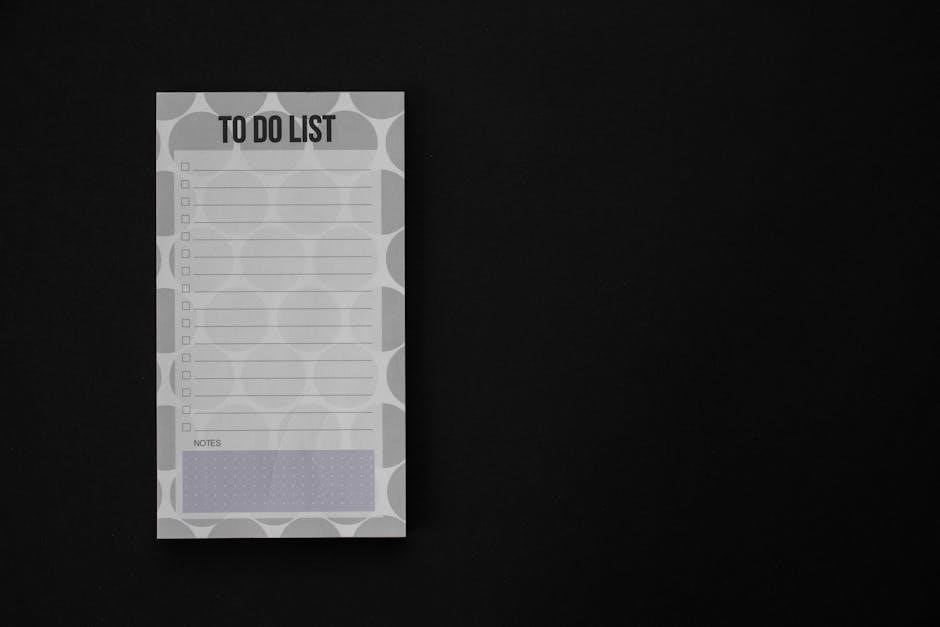
PDF templates frequently feature dedicated spaces for noting task details, deadlines, and estimated completion times. Some advanced templates incorporate color-coding systems for visual organization, categorizing tasks by project or type. The inclusion of a “Notes” section allows for capturing important context or reminders.
Furthermore, popular templates often include a “Review” or “Reflection” area, encouraging users to assess their time boxing effectiveness and identify areas for improvement. Customizable fields are also common, enabling users to tailor the template to their unique needs and workflows. These features collectively contribute to a more structured and efficient time management process.
Customizing a Time Boxing Template to Your Needs
While pre-designed time boxing template PDFs offer a solid foundation, tailoring them to your individual workflow is crucial for maximizing effectiveness. Begin by adjusting the time block durations to align with your concentration span and task complexity. Some individuals thrive with 25-minute blocks, while others prefer longer, 90-minute intervals.
Modify the task prioritization system to reflect your personal criteria. Consider adding custom priority levels or incorporating a task scoring method. Don’t hesitate to add or remove sections based on your requirements; a dedicated space for “Energy Levels” or “Potential Distractions” can be beneficial.
PDF editing software allows you to change fonts, colors, and layouts for improved visual clarity. Experiment with different formatting options to create a template that resonates with your preferences. Remember, the goal is to create a tool that seamlessly integrates into your routine, fostering consistent and productive time management.
Step-by-Step Guide to Using a Time Boxing Template
Step 1: Download & Print/Digital Access: Obtain your chosen time boxing template PDF and either print a physical copy or access it digitally using a PDF editor. Ensure you have pens/highlighters for physical templates or editing tools for digital versions.
Step 2: Task Listing: Brainstorm all tasks needing completion. Be specific – break down large projects into smaller, manageable steps. Write each task clearly within the template’s designated space.
Step 3: Prioritization: Assign priorities to each task (High, Medium, Low). This guides allocation during scheduling. Use color-coding or numerical ranking for visual clarity.
Step 4: Block Scheduling: Allocate specific time blocks to each prioritized task. Be realistic about time estimates. Avoid over-scheduling; leave buffer time for unexpected issues.
Step 5: Execution & Monitoring: During each time block, focus solely on the assigned task. Track progress and note any interruptions. Regularly review and adjust the schedule as needed.
Setting Realistic Time Blocks
Accurate estimation is crucial when utilizing a time boxing template PDF. Begin by tracking how long similar tasks actually take – avoid optimistic guesswork. Consider potential interruptions; build in buffer time (10-20%) to accommodate unexpected delays.
Start small: Initially, experiment with shorter time blocks (25-50 minutes) followed by brief breaks. This mirrors techniques like the Pomodoro method, enhancing focus and preventing burnout. Gradually increase block duration as concentration improves.
Task complexity matters: Complex tasks require longer, uninterrupted blocks. Simpler, routine tasks can be grouped into shorter segments. Your PDF template should allow for flexible block lengths.
Be honest with yourself: Don’t overestimate your capacity. It’s better to underestimate and finish early than to overestimate and feel overwhelmed. Regularly review completed time boxes to refine future estimations.
Iterative approach: Setting realistic blocks is an ongoing process. Adjust based on experience and self-awareness.

Prioritizing Tasks for Time Boxing
Effective time boxing with a PDF template hinges on task prioritization. Employ methods like the Eisenhower Matrix (Urgent/Important) to categorize tasks. Focus first on “Important & Urgent” items, allocating them prime time blocks.
Identify your MITs (Most Important Tasks): Each day, determine 1-3 critical tasks that must be completed. Schedule these during your peak performance hours. Your PDF template should facilitate highlighting or marking these priorities.
Consider task dependencies: Some tasks require completion before others can begin. Sequence your time blocks accordingly to avoid bottlenecks. Visualize this flow within your template.
Don’t schedule everything: Leave room for flexibility and unexpected issues. Over-scheduling leads to stress and reduced effectiveness. A well-designed PDF template allows for unscheduled blocks.
Regular review: Re-evaluate priorities daily. Circumstances change, and your time boxing schedule must adapt. Use your template to easily adjust task order and block allocation.
Dealing with Interruptions During Time Boxes
Interruptions are inevitable, even with a meticulously planned time boxing template PDF. The key is to minimize their impact. First, proactively reduce distractions – silence notifications, close unnecessary tabs, and inform colleagues of your focused work periods.
The “Park It” Method: When an interruption arises, quickly jot it down on a separate “Interruption List” within or alongside your PDF template. Acknowledge the request, but defer it until your current time box concludes.
Assess Urgency: Is the interruption truly urgent? If not, politely explain you’re in a focused work block and will address it shortly. A clear boundary is crucial.
Buffer Time: Incorporate small buffer blocks into your schedule to absorb minor interruptions without derailing your entire day. Your PDF template should allow for this flexibility.
Review Interruptions: At the end of each day, review your “Interruption List.” Schedule time to address these items, prioritizing them as needed. This prevents tasks from falling through the cracks.
Reviewing and Adjusting Your Time Boxing Schedule
Regular review is vital for maximizing the effectiveness of your time boxing template PDF. Don’t treat your initial schedule as set in stone; it’s a living document requiring adaptation. At the end of each day, briefly assess what worked and what didn’t.
Analyze Completion Rates: Did you consistently finish tasks within their allocated time boxes? If not, were the time estimates unrealistic, or were interruptions a significant factor? Your PDF template can include a section for noting these observations.
Identify Bottlenecks: Are certain types of tasks consistently taking longer than expected? This signals a need to either break them down into smaller steps or adjust your time estimates.
Flexibility is Key: Life happens. Be prepared to reschedule time boxes when unexpected events occur. Your PDF template should facilitate easy adjustments without requiring a complete overhaul.
Weekly Review: Conduct a more thorough review weekly. Evaluate your overall productivity and identify patterns. Refine your time boxing approach based on these insights, ensuring continuous improvement.
Time Boxing vs. Other Time Management Techniques (Pomodoro, Task Lists)
While time boxing, often facilitated by a time boxing template PDF, shares goals with techniques like Pomodoro and task lists, it differs in approach. Traditional task lists prioritize what needs doing, lacking a dedicated time component.
Pomodoro Technique focuses on short, focused bursts (typically 25 minutes) with brief breaks. It’s excellent for maintaining concentration but doesn’t inherently schedule larger blocks of time for complex projects. A PDF template allows for pre-planned, longer durations.

Time boxing proactively allocates specific time slots for tasks, forcing prioritization and realistic scheduling. It’s more holistic, addressing both task completion and time allocation. Using a PDF template provides a visual overview of your day, unlike fragmented Pomodoro sessions.
Synergy is Possible: These techniques aren’t mutually exclusive. You can integrate Pomodoro intervals within a time box for focused work. A time boxing template PDF can even include space to note Pomodoro cycles completed.
Ultimately, the best technique depends on individual preferences and task complexity. Time boxing, with its structured approach, often proves superior for managing larger projects and preventing time overruns.
Advanced Time Boxing Strategies

Beyond basic implementation, leveraging a time boxing template PDF unlocks advanced strategies for maximized productivity. Theme Days involve dedicating entire days to specific task categories – marketing, administration, creative work – streamlining focus.
Buffer Blocks are crucial. Schedule 15-30 minute blocks between time boxes to accommodate unexpected interruptions or tasks that run over. A well-designed PDF template includes space for these buffers.
Timeboxing “Deep Work” requires blocking out significant, uninterrupted periods (2-4 hours) for cognitively demanding tasks. Minimize distractions and communicate unavailability during these blocks.
The Eisenhower Matrix (urgent/important) integrates seamlessly. Prioritize tasks within your time boxing template PDF based on urgency and importance, tackling high-priority items first.
Regular Review & Iteration is key. Analyze completed time boxes – what worked, what didn’t? Adjust future schedules based on these insights. A PDF template can include a “lessons learned” section.
Finally, consider nested time boxes – breaking down large tasks into smaller, manageable time blocks within a larger allocated timeframe, enhancing control and progress tracking.
Tools to Complement Your Time Boxing Template
While a time boxing template PDF provides structure, several digital tools amplify its effectiveness. Calendar applications (Google Calendar, Outlook) integrate seamlessly, allowing for visual scheduling and reminders linked to your time blocks.
Task management software (Todoist, Asana, Trello) complements time boxing by detailing tasks within each time block. This creates a clear action plan for each allocated period.
Focus apps (Freedom, Forest) block distracting websites and applications during “deep work” time boxes, enhancing concentration. These are vital for maintaining focus.
Time tracking tools (Toggl Track, Clockify) provide data on how you actually spend your time, revealing inefficiencies and informing adjustments to your PDF template.
Note-taking apps (Evernote, OneNote) are useful for capturing ideas and insights during or after time boxes, fostering continuous improvement.
Finally, consider Pomodoro timers for breaking down larger time blocks into focused intervals with short breaks, boosting sustained concentration alongside your time boxing template PDF.
Troubleshooting Common Time Boxing Challenges

Even with a well-designed time boxing template PDF, challenges arise. Overestimation of task duration is frequent; start by tracking actual time spent to refine future blocks.
Unexpected interruptions are inevitable. Build buffer time into your schedule or learn to politely defer non-urgent requests. Acknowledge the interruption, reschedule, and return to your time box;
Difficulty sticking to the schedule can occur. Treat time blocks as firm commitments, and minimize distractions. Use focus apps to enforce boundaries.
Perfectionism can derail progress. Remember, completion is better than perfection. Focus on delivering a “good enough” result within the allotted time.
Feeling overwhelmed? Break down large tasks into smaller, manageable chunks within multiple time boxes. Prioritize ruthlessly using your PDF template.
Regularly review and adjust your schedule based on your experiences. Your time boxing template PDF is a living document, not a rigid constraint.
Examples of Time Boxing Templates for Different Scenarios (Work, Study, Personal)
A work-focused time boxing template PDF might allocate blocks for “Email Management (30 mins),” “Project X – Coding (2 hours),” and “Client Meeting Prep (1 hour).” These prioritize revenue-generating activities.
For students, a PDF template could include “Lecture Review (1.5 hours),” “Assignment – Essay Writing (2.5 hours),” and “Practice Problems – Math (1 hour).” This supports focused study sessions.
Personal time boxing utilizes a PDF template with blocks like “Exercise (45 mins),” “Meal Planning & Grocery Shopping (1 hour),” “Family Time (2 hours),” and “Personal Project – Painting (1.5 hours).”
Templates can vary in complexity. Some are simple hourly grids, while others include task lists, priority levels, and notes sections.
Many free PDF templates offer pre-defined blocks, while others are fully customizable; Consider a digital PDF template for easy editing and scheduling integration.
Adapt the template to your needs. The key is consistent, focused effort within defined time boundaries, regardless of the scenario.