
Written in Bone PDF Free: A Comprehensive Article Plan
Exploring the demand for a “Written in Bone” PDF reveals numerous online sources, like dokumen.pub, offering access. However, discerning legality and ethical considerations surrounding free PDF downloads is crucial.
Published in 2021, the book, authored by Sue Black, has gained popularity, prompting searches for readily available digital copies.
Overview of “Written in Bone”
“Written in Bone: Hidden Stories in What We Leave Behind,” penned by forensic anthropologist Sue Black, offers a captivating journey into the world of skeletal remains and the narratives they hold. Published in 2021, the book isn’t a typical crime thriller, but rather a detailed exploration of how bones can reveal profound insights into the lives – and deaths – of individuals from centuries past.
Black masterfully blends scientific rigor with compelling storytelling, taking readers beyond the sterile laboratory and into the heart of archaeological digs and forensic investigations. The book delves into the techniques used to analyze skeletons, uncovering details about a 19th-century New Orleans cholera epidemic and the lives of those affected. It’s a fascinating look at how skeletal analysis can illuminate past populations’ health, diet, trauma, and even social status.

The appeal of “Written in Bone” extends beyond the forensic science community. Its accessibility and engaging narrative have garnered a wide readership, leading to increased online searches for digital versions, including PDF formats. However, as with any popular title, the availability of free PDFs raises questions about copyright and ethical sourcing.
The book’s length is 336 pages.
Author Background: Sue Black
Sue Black is a highly respected forensic anthropologist with a distinguished career dedicated to the study of human remains. She is known for her practical, hands-on approach to forensic science, honed through years of experience working with law enforcement and assisting in complex investigations. Black isn’t simply an academic; she’s a field anthropologist who has personally excavated and analyzed countless skeletons.
Prior to “Written in Bone,” Black gained prominence with her memoir, “All That Remains,” which detailed her unconventional path to becoming a leading figure in forensic anthropology. Her work often involves identifying human remains, determining cause of death, and providing crucial evidence in criminal cases. She holds a prominent position within the academic community, lecturing and conducting research that pushes the boundaries of skeletal analysis.

Black’s ability to translate complex scientific concepts into accessible language is a key factor in the popularity of her books, including “Written in Bone.” The demand for digital copies, like a “Written in Bone” PDF, stems partly from her engaging writing style and the fascinating subject matter she presents. Her expertise lends credibility and depth to the stories revealed within the bones.
She is a professor at the University of Dundee.
Core Themes and Focus of the Book
“Written in Bone” delves into the captivating world of forensic anthropology, revealing the stories hidden within the human skeleton. The book’s central theme revolves around the idea that bones are not merely inert remains, but rather repositories of information about a person’s life, health, and even their circumstances surrounding death. Sue Black masterfully illustrates how skeletal analysis can unlock narratives of past lives, offering insights into historical populations and individual experiences.
The book focuses on a specific case study – the analysis of a large collection of skeletons unearthed from a burial ground in Spitalfields, London. Through meticulous examination, Black and her team reconstruct the lives of individuals who lived centuries ago, revealing details about their diet, diseases, traumas, and social status. The narrative emphasizes the power of skeletal remains to provide a voice to the voiceless.

While the search for a “Written in Bone” PDF is common, the book’s core message transcends mere accessibility. It highlights the importance of forensic science in understanding the past and its relevance to contemporary issues, such as identifying missing persons and solving cold cases. The book’s appeal lies in its blend of scientific rigor and compelling storytelling.
The Science of Skeletal Analysis

Skeletal analysis, as detailed in “Written in Bone,” is a multifaceted scientific discipline rooted in osteology, archaeology, and forensic science. It involves the systematic examination of human skeletal remains to extract biological information. This process begins with establishing the skeletal inventory – identifying all present bones and fragments – followed by assessing their condition and any visible modifications.
Key techniques include macroscopic observation for trauma (fractures, cut marks), and microscopic analysis to detect disease or nutritional deficiencies. Metric analysis, involving precise measurements of bones, aids in determining age, sex, and stature. Non-metric traits, such as variations in bone shape, can provide clues about ancestry and population affiliation.
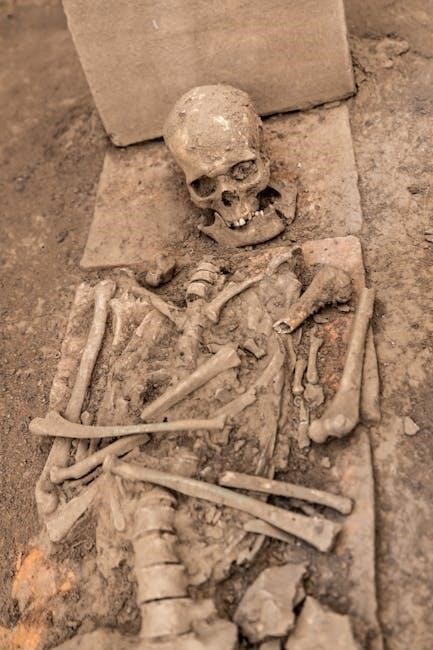
The pursuit of a “Written in Bone” PDF often stems from a desire to understand these techniques. The book elucidates how scientists differentiate between antemortem (before death) and postmortem (after death) damage, crucial for forensic investigations. It emphasizes the importance of contextual information – the archaeological setting and associated artifacts – in interpreting skeletal findings accurately. Ultimately, skeletal analysis transforms fragmented remains into compelling life stories.
Forensic Anthropology Explained

Forensic anthropology, a core focus of “Written in Bone,” applies skeletal biological anthropology to legal contexts. It’s the scientific analysis of human remains for the purpose of establishing identity and determining the circumstances surrounding death. This field bridges the gap between archaeological science and the criminal justice system, often assisting law enforcement in investigations.
The discipline encompasses a wide range of techniques, including skeletal trauma analysis to identify the type of weapon used or the manner of death. Estimating time since death (postmortem interval) is another critical aspect, relying on decomposition rates and environmental factors. A search for a “Written in Bone” PDF often indicates interest in these investigative methods.
Sue Black’s work highlights the importance of meticulous documentation and chain of custody for skeletal evidence. Forensic anthropologists work closely with other specialists – pathologists, odontologists, and entomologists – to build a comprehensive picture of events. The goal is to provide objective, scientifically sound testimony in court, aiding in the pursuit of justice.
What Bones Reveal About Diet and Health
Human bones are remarkable archives of an individual’s life, offering insights into their diet and overall health. “Written in Bone” delves into how skeletal analysis can reveal nutritional deficiencies, chronic illnesses, and even occupational stress. Isotopic analysis, for example, can pinpoint geographical origins and dietary staples based on the chemical composition of bone tissue.

Evidence of diseases like anemia, arthritis, or tuberculosis can be identified through specific bone lesions and changes in bone density. Dental health, or lack thereof, provides clues about carbohydrate intake and access to resources. The search for a “Written in Bone” PDF often stems from a fascination with these detective-like capabilities.
Furthermore, bones can indicate periods of famine or abundance, reflecting broader societal conditions. Growth arrest lines, visible in developing bones, mark times of stress during childhood. By studying these skeletal markers, forensic anthropologists reconstruct past lifestyles and health patterns, offering a unique perspective on human history.
Identifying Trauma and Violence in Skeletons
Skeletal remains frequently bear the silent testimony of past trauma and violence. “Written in Bone” meticulously details how forensic anthropologists identify injuries inflicted before, around, or after death. Blunt force trauma, sharp force trauma, and projectile injuries all leave distinct marks on bone, revealing the type of weapon used and the manner of attack.
Healed fractures indicate past injuries, while perimortem fractures – those occurring around the time of death – suggest a violent event. Patterns of breakage can differentiate between accidental falls and intentional acts. The increasing interest in accessing a “Written in Bone” PDF reflects a public fascination with these investigative techniques.
Furthermore, evidence of interpersonal violence, such as defensive wounds, can be identified. Microscopic analysis can reveal subtle signs of bone remodeling in response to trauma. By carefully examining these skeletal indicators, forensic anthropologists contribute to solving cold cases and understanding patterns of violence in past populations;
Determining Age and Sex from Skeletal Remains
Forensic anthropology relies heavily on accurately estimating age and sex from skeletal remains, crucial steps in identifying individuals. “Written in Bone” explains how these estimations are made, utilizing developmental stages and morphological characteristics. Age determination involves assessing bone fusion, epiphyseal closure, and degenerative changes – indicators that progress predictably with time.

Sex estimation primarily focuses on the pelvis and skull, as these bones exhibit distinct sexual dimorphism. Pelvic features, like the subpubic angle and sciatic notch, differ significantly between males and females. Cranial characteristics, such as the brow ridge and mastoid process, also provide valuable clues. The demand for a “Written in Bone” PDF suggests a broad interest in these methods.
While these techniques aren’t foolproof, they provide a statistical probability of age and sex. Combining these estimations with other findings, like stature and ancestry, increases the accuracy of identification, aiding in legal investigations and historical research.
Ancestry and Geographic Origin from Bone Analysis
Skeletal analysis can offer insights into an individual’s ancestral background and geographic origin, though it’s a complex and often probabilistic science. “Written in Bone” details how forensic anthropologists utilize non-metric traits – subtle morphological features – to estimate ancestry. These traits, varying in frequency among different populations, include skull shape, nasal aperture, and facial projection.
However, it’s crucial to understand that ancestry estimation isn’t about pinpointing a specific country or ethnicity. Rather, it provides a range of possibilities based on observed traits and comparisons to established population databases. Geographic origin can be inferred through isotopic analysis of bone collagen, revealing dietary patterns linked to specific regions.
The increasing interest in accessing a “Written in Bone” PDF reflects a growing public fascination with these techniques. Ethical considerations are paramount, as misinterpreting ancestry can have significant social and legal consequences. Accurate analysis requires expertise and a nuanced understanding of human variation.
Case Studies Featured in “Written in Bone”
Sue Black’s “Written in Bone” isn’t merely a textbook on forensic anthropology; it’s enriched by compelling case studies that illustrate the application of skeletal analysis in real-world investigations. These narratives bring the science to life, showcasing how bones can reveal stories of trauma, disease, and identity. The book delves into historical cases, examining skeletal remains from various contexts – mass graves, archaeological sites, and individual discoveries.
Black meticulously details the process of reconstructing events from fragmented remains, highlighting the challenges and triumphs of forensic work. The cases demonstrate the power of combining scientific techniques with historical research and contextual evidence. The demand for a “Written in Bone” PDF suggests a strong public interest in these true crime-esque accounts.
These case studies underscore the ethical responsibility of forensic anthropologists to treat remains with respect and to advocate for the deceased. They also emphasize the importance of accurate and unbiased interpretation of skeletal evidence.
The Role of “Written in Bone” in Forensic Science Education
Sue Black’s “Written in Bone” has become a significant resource within forensic science education, bridging the gap between complex scientific principles and their practical application. Its accessible writing style, coupled with detailed case studies, makes it suitable for both undergraduate students and professionals seeking to expand their knowledge.
The book effectively illustrates the methodologies of skeletal analysis, trauma identification, and ancestry estimation, providing a foundational understanding of forensic anthropology. Instructors often utilize “Written in Bone” to supplement lectures and lab exercises, fostering critical thinking and analytical skills among students. The widespread interest, evidenced by searches for a “Written in Bone” PDF, highlights its relevance.
Furthermore, the book’s emphasis on ethical considerations and the importance of respectful treatment of human remains promotes a responsible approach to forensic investigation. It encourages students to view skeletal remains not merely as evidence, but as individuals with stories to tell.
Availability of “Written in Bone” PDF – Legality and Ethics
The proliferation of websites offering a “Written in Bone” PDF raises significant legal and ethical concerns. Downloading copyrighted material without authorization constitutes copyright infringement, potentially leading to legal repercussions for the user. Sites like dokumen.pub, while providing access, operate in a legally gray area, often distributing content without proper licensing.
Ethically, supporting unauthorized distribution undermines the author’s intellectual property rights and the publishing industry. Authors rely on book sales to sustain their work and continue producing valuable educational resources. Seeking free PDFs devalues their contributions and discourages future scholarship.
Furthermore, illegally downloaded PDFs may contain malware or viruses, compromising the user’s device and personal information. The quality of these files is often substandard, potentially hindering comprehension and learning. Prioritizing legal and ethical access ensures both the integrity of the content and the safety of the user.
Legitimate Sources for Purchasing the Book
For readers seeking authorized access to “Written in Bone,” numerous legitimate purchasing options are readily available. Major online retailers like Amazon, Barnes & Noble, and Bookshop.org offer both physical copies and eBook versions, ensuring a secure and legal transaction. These platforms directly support the author and publisher, contributing to the continuation of forensic anthropology literature.
Directly purchasing from the publisher’s website is another reliable option, often providing exclusive editions or bundled offers. Libraries represent an excellent, cost-effective resource, offering physical copies for borrowing and, increasingly, digital access through library lending programs.
eBook platforms like Kindle and Kobo provide convenient digital reading experiences, allowing users to access the book on various devices. Avoiding unauthorized PDF downloads and opting for these legitimate sources guarantees a high-quality reading experience while upholding copyright laws and supporting the author’s work.
Risks Associated with Downloading Illegal PDFs
Downloading “Written in Bone” from unauthorized sources, such as websites offering free PDFs, carries significant risks. These files often harbor malware, viruses, and spyware, potentially compromising your device and personal data. Such downloads frequently violate copyright laws, exposing users to legal repercussions, including fines and potential lawsuits.
Websites distributing illegal PDFs are often riddled with deceptive advertising and phishing scams, designed to steal sensitive information like credit card details or login credentials. The quality of these PDFs is frequently substandard, containing missing pages, formatting errors, or even intentionally altered content.
Supporting illegal downloads undermines the author’s livelihood and the publishing industry, hindering the creation of future forensic anthropology works. Choosing legitimate purchasing options protects your digital security, respects intellectual property rights, and ensures access to a reliable, high-quality reading experience. Prioritizing legal avenues safeguards both your device and the future of authorship.
Alternatives to Free PDF Downloads (Libraries, eBooks)

Seeking alternatives to illegally downloaded “Written in Bone” PDFs offers safe and ethical access to this fascinating work. Public libraries frequently stock the book in physical format, providing free borrowing options with a library card. Many libraries also offer digital lending services, allowing access to eBooks through platforms like Libby or OverDrive, eliminating the need for unauthorized downloads.
Reputable eBook retailers, such as Amazon Kindle, Barnes & Noble Nook, and Google Play Books, provide legal digital copies for purchase. These platforms often feature competitive pricing and promotional offers, making eBooks an affordable alternative. Subscription services like Scribd offer access to a vast library of books, including potentially “Written in Bone,” for a monthly fee.
Supporting authors and publishers through legitimate channels ensures continued production of valuable forensic anthropology literature. Exploring these alternatives protects your device from malware and respects copyright laws, fostering a sustainable ecosystem for both readers and creators.
Reviews and Critical Reception of “Written in Bone”
“Written in Bone” has garnered significant attention, receiving positive reviews for its accessible exploration of forensic anthropology. Critics praise Sue Black’s ability to translate complex scientific concepts into engaging narratives, making the book appealing to both specialists and general readers. The book was longlisted for awards, indicating its quality and impact within the genre.
Reviewers consistently highlight the compelling case studies presented, showcasing how skeletal analysis can reveal hidden stories about past lives. The author’s expertise and passion for the subject matter shine through, creating a captivating reading experience. Many commend Black’s respectful and ethical approach to handling human remains, emphasizing the importance of dignity in forensic investigations.
While specific detailed reviews aren’t readily available in the provided snippets, the overall sentiment suggests a well-received and informative book. The demand for a “Written in Bone” PDF likely stems from its popularity and the desire for convenient access to this acclaimed work.
Impact of the Book on Public Understanding of Forensic Anthropology
“Written in Bone” has demonstrably broadened public awareness of forensic anthropology, demystifying the science behind skeletal analysis. Sue Black’s accessible writing style and compelling case studies have captivated readers, fostering a greater appreciation for the field’s complexities and contributions to solving crimes and understanding history.
The book’s success has likely fueled increased interest in forensic science education and careers. By showcasing the meticulous work involved in identifying individuals and reconstructing past lives from bones, “Written in Bone” challenges popular misconceptions often perpetuated by television dramas. It emphasizes the scientific rigor and ethical considerations inherent in the discipline.
The widespread search for a “Written in Bone” PDF suggests a significant audience eager to learn more about this fascinating area of science. This demand highlights the book’s effectiveness in communicating complex information to a broad readership, ultimately contributing to a more informed public understanding of forensic anthropology.
Future Directions in Skeletal Biology and Forensic Research
Advancements in skeletal biology and forensic research are rapidly evolving, building upon the foundational principles explored in works like “Written in Bone.” Emerging technologies, such as advanced DNA analysis and 3D scanning, promise to enhance the accuracy and efficiency of skeletal identification and trauma analysis.
Current research focuses on refining methods for estimating ancestry and geographic origin from bone isotopes, providing more precise insights into past migration patterns and lifestyles. Furthermore, the integration of artificial intelligence and machine learning algorithms is poised to revolutionize skeletal age and sex estimation.
Despite the accessibility challenges presented by searches for a “Written in Bone” PDF, the book’s core message – the power of skeletal remains to reveal hidden stories – continues to inspire researchers. Future investigations will likely prioritize non-destructive analytical techniques and ethical considerations, ensuring the respectful treatment of human remains while maximizing their scientific value.